


The basic laws of building a sukkah are explained in our article, Sukkah Building Basics From the Inside Out - Sukkology 101. Here, we’ll address some practical questions that commonly arise when building and using a sukkah: What if a tree branch or roof hangs over the sechach? Can the walls move in the wind? What about a gap in the sechach? How should the sechach be supported, and what about using sechach mats?
A Sukkah Under a Tree
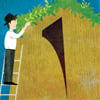
A sukkah must be directly under the open sky, with nothing intervening between the sechach and the sky. As such, tree branches may not hang over the sechach, even if they are high above the sukkah.1
If the tree is beside the sukkah and its branches do not extend over the sechach, the sukkah remains kosher, even if the tree casts shade over the entire sukkah.2 Similarly, if the branches do not normally extend over the sukkah but occasionally sway over it because of the wind, the sukkah remains valid.3
What If Branches Cover Only Part of the Sukkah?
Ideally, the entire sukkah should be under the open sky. However, if tree branches cover only part of the sukkah, the remainder can still be kosher, provided that:
- The sechach covering the rest of the sukkah provides more shade than sunlight.4
- The branches do not extend 4 amot (approximately 75.6 inches/192 cm) down the side of the sukkah. If they do, that entire side may be considered as though it has no wall. Unless three kosher walls remain, the entire sukkah may therefore be invalid.5
- The branches do not cover 4 tefachim (approximately 12.6 inches/32 cm) across the middle of the sukkah. In a sukkah that is only the minimum required size, even an overhang of 3 tefachim (approximately 9.5 inches/24 cm) can be enough to invalidate it.6
Even when the remainder of the sukkah is kosher, one may not eat directly beneath the area where the tree branches overhang when they constitute an area of invalid sechach, as explained below.
What If There Is a Gap in the Sechach?
A small gap in the sechach is not necessarily a problem, but it is treated more stringently than invalid sechach.7
If there is 3 tefachim (approximately 9.5 inches/24 cm) or more of empty space in the sechach, the sukkah can be invalid. This is true whether the gap is in the middle of the sukkah or along one of the edges. If the gap is less than 3 tefachim, the sukkah remains kosher, although one should not eat directly beneath the gap.8
There is an important qualification: a gap of 3 tefachim only invalidates the sukkah when it divides the sukkah in a way that prevents a kosher minimum-sized sukkah with the required walls from remaining intact. If a complete kosher sukkah remains on one side of the gap, that section remains valid.9
This differs from invalid sechach, such as being covered by an overhanging roof or tree branch. Invalid sechach generally becomes significant at 4 tefachim (approximately 12.6 inches/32 cm) rather than 3 tefachim. The reason for the stricter rule regarding empty space is that an actual gap is more noticeable and therefore has a greater impact on the definition of a sukkah.10
In addition, the principle of dofen akumah (a halachic concept, literally “a bent wall,” under which certain invalid sechach adjacent to a wall may be viewed as though the wall bends inward until it reaches the kosher sechach) cannot be used to bridge an area of empty space. Therefore, depending on the location of the gap, even an outer section of the sukkah may be invalid if it cannot combine with the kosher sechach to form a complete sukkah.11
As always, one may not eat directly beneath an area that is halachically considered empty space or invalid sechach.
May One Eat in the Sukkah Under a Tree or Other Invalid Sechach?
The status of the area beneath a tree or other invalid sechach depends on its size and location.
If it extends from one side of the sukkah to the other: If the area is 4 tefachim (approximately 12.6 inches/32 cm) or more wide, it can divide the sukkah and potentially invalidate it, depending on the sukkah's structure. If it is less than 4 tefachim, the sukkah remains kosher and one may technically eat beneath it.12 Nevertheless, when it is 3 tefachim (approximately 9.5 inches/24 cm) or more, it is proper to be stringent and not eat there. If it is less than 3 tefachim, one may eat there according to all opinions.13
If it does not extend from one side to the other: If the area is 4 × 4 tefachim (approximately 12.6 × 12.6 inches/32 × 32 cm) or more, one may not eat beneath it. If it is smaller than 4 × 4 tefachim, one may eat there.14
If it is adjacent to a wall: If the area is less than 4 tefachim (approximately 12.6 inches/32 cm) wide, one may technically eat beneath it, although it is proper to be stringent when it is 3 tefachim or more. If it is more than 4 tefachim but less than 4 amot (approximately 75.6 inches/192 cm) wide, the sukkah can remain kosher through the principle of dofen akumah (“a bent wall”), but one may not eat beneath the invalid sechach. If it is 4 amot (approximately 75.6 inches/192 cm) or more, the adjacent wall may be considered nonexistent, potentially invalidating the entire sukkah if three kosher walls do not remain.15
What if an Overhang Covers One of the Sukkah’s Walls?
A sukkah requires at least three walls. Therefore, if three kosher walls remain after disregarding a wall covered by an overhang, the sukkah can remain kosher. But what if the overhang covers one of the three walls, or extends over several walls?
The Mishnah teaches that dofen akumah (“a bent wall”) can allow an overhang to be considered part of the wall.16 For example, if a house has an opening in its roof and kosher sechach is placed over the opening, the sukkah can be kosher when the walls are within 4 amot (approximately 75.6 inches/192 cm, according to Rav Chaim Naeh) of the sechach. Halachically, we view the ceiling as though it bends upward toward the sechach.
However, there is a dispute as to whether dofen akumah can be used when the wall itself does not reach the sechach. Some authorities rule that it cannot,17 while others maintain that we can consider the wall as extending upward to reach the sechach.18 Practically, many advise being stringent regarding this issue.19
Another question arises when the wall does reach the sechach, but the overhang itself is higher than the sechach. This is common when an existing roof or balcony extends over the sukkah. Some authorities question whether dofen akumah can be applied in this situation, since the overhang is not at the same height as the sechach.20 Others permit it, applying the principle of chavot rami (“lowering the ceiling”) together with dofen akumah.21
One simple practical solution is to place something across the area beneath the overhang, at the same height as the sechach. This creates a “ceiling” at the level of the sechach, allowing dofen akumah to be applied without relying on the more lenient combination of chavot rami and dofen akumah. This covering does not need to be kosher sechach and can be made from any material.22
Important Note: It is important to mark off the area of the sukkah which is under the roof. Since this is considered a “bent wall,” if you sit there, you are technically under a wall, not the sechach, and you do not fulfill the mitzvah.
Is It a Problem if the Sukkah Walls Move in the Wind?
Sukkah walls should be firmly secured so that they do not move in the wind. A wall that moves in a regular wind is not considered a valid wall according to halachah.23 There are different opinions as to how much movement is enough to invalidate a wall, so ideally the walls should not move at all.24
This can be difficult with canvas sukkah walls. One solution is to use taut straps around the sukkah. The straps should be placed no more than 3 tefachim (approximately 9 inches/24 cm) apart, with the lowest strap within 3 tefachim of the ground.
This creates a halachically-valid wall based on the principle of lavud: when the space between two objects is less than 3 tefachim, halachah considers them as though they are joined and that the space between them is filled in. Thus, a series of taut straps placed within 3 tefachim of one another can form a valid wall, even if the canvas itself moves in the wind.25
What May Be Used to Support or Secure the Sechach?
Ideally, sechach should be supported by materials that are themselves kosher for sechach.26 As such, one should not place sechach directly on metal or plastic poles. Instead, place wooden beams over the poles and rest the sechach on the wood.
Similarly, one should not nail, wire, or tie the sechach down with synthetic rope or other non-kosher materials. Although the sechach itself is kosher, we avoid using materials that are not fit for sechach to hold it in place, as this can lead to confusion about what may be used as sechach itself.27
If the sechach needs to be secured against the wind, cotton or hemp string may be used, or heavy wooden beams can be placed on top of the sechach to weigh it down.
When using sechach mats woven with plastic or synthetic wire, care should be taken that the mats are supported by the wooden beams themselves, rather than by the plastic or wire.
One may, however, place the sechach directly on a wall made of stone, even though it isn’t kosher for sechach, since no one will get confused and assume stone is kosher for sechach.28
Nevertheless, after the fact, or in a pressing situation, the sukkah is still kosher if the sechach is supported by materials that aren’t themselves kosher for sechach.29
There is no issue of using other material for the “support to what supports” the sechach.30
What About Using Sechach Mats?
While you can use anything that has grown and isn’t susceptible to tumah (ritual impurity) as sechach, it has become popular to use bamboo mats. It is, however, important to keep in mind that not every mat is suitable. A mat that is originally made for sitting or reclining is generally not kosher for sechach. Since mats can be manufactured for different purposes, it is important to ascertain its original purpose.31
Mats woven with metal wire also raise concerns, since metal is susceptible to tumah (ritual impurity), and some consider such mats unsuitable for sechach. Others permit them. Mats woven with natural materials are preferable, provided they were not made for sitting or reclining.32
Because of the above concerns, if one chooses to use bamboo mats, it may be best to choose a mat with a reliable certification.





Start a Discussion